

What Happens If You Don't Pay Dc Speed Camera Ticket
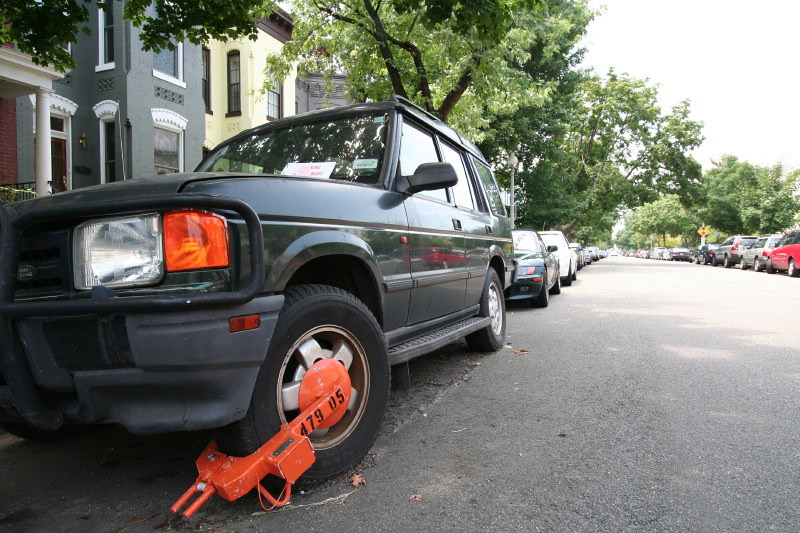
A DC boot past Kendrick Hang licensed under Creative Eatables.
The idea backside traffic enforcement has a elementary logic. When a driver is caught breaking the law — for instance, by running a red light at the site of a red lite camera — they become a ticket. The threat of paying that fine then incentivizes that commuter, as well as other drivers who know ticketing is taking place, to follow the law.
But what happens when some drivers aren't paying those fines? A DC Council roundtable Monday focused on that question.
DC'southward Department of Public Works can boot drivers when they have two or more than parking or Automated Traffic Enforcement (ATE) tickets that are more threescore days erstwhile. The traffic cameras fine drivers for moving violations: speeding and running ruby-red lights or stop signs.
Advocates — including my colleagues on the policy side of GGWash (per our editorial policy, they were non involved in the publication of this article) — have pushed for more emphasis on traffic cameras to enforce safety laws while preventing encounters with law that tin evidence dangerous for Black and chocolate-brown drivers. (A note: GGWash policy manager Alex Baca testified at Monday's roundtable.)
Merely even every bit cameras are becoming an increasingly of import enforcement tool, questions remain about how well they are reining in unsafe drivers if many of them are able to merely ignore tickets.
According to Councilmember Mary Cheh, chair of the DC Council'south Committee on Transportation and the Environs, well-nigh 550,000 vehicles beyond DC, Maryland, and Virginia are currently boot-eligible, many for moving violations. Nigh 75,000 of those vehicles were ticketed for going 21 mph over the speed limit; 150,000 ran cherry-red lights; and l,000 ran stop signs.
A modest fraction of those vehicles are racking upward dozens upon dozens of violations. DPW told Cheh that there are more than than three,000 vehicles with more than xx outstanding ATE tickets; 500 with more than forty violations; and fifty-fifty a Virginia driver with more than than 180 violations.
Co-ordinate to Cheh, it's not clear whether the cars racking up these tickets are disproportionately responsible for the deaths and injuries that DC'due south Vision Goose egg program has been trying in vain to reduce because police don't link that data. Merely anecdotally, drivers with outstanding tickets have been involved in incidents like the crash that injured a father and his two young daughters in Congress Heights on Walk to Schoolhouse Day in October.
— Christina Henderson (@chenderson) December 6, 2021Starting now: T&E Roundtable on DPW Traffic Enforcement. We got a information dump of boot eligible vehicle info. My staff did some assay…
Alibi my language merely what in the absolute eff?!?! These aren't parking tickets. We take a serious problem here. movie.twitter.com/bmdnNY0Fll
What is articulate, withal, is that of those thousands of cars with outstanding tickets, simply a small fraction are beingness booted, and plenty accept been spotted on DC streets. At Monday's roundtable, councilmembers questioned DPW Director Christine Davis and Deputy Mayor for Operations and Infrastructure Lucinda Babers, to enquire what'southward going wrong.
Booting and towing and points, oh my!
One major reason tickets aren't getting enforced is capacity: According to DPW's Davis, DC currently has just iv people on its booting crew, and they're simply able to boot almost 50 cars per twenty-four hours. To kicking every currently eligible vehicle at that charge per unit would have 25 years.
At the electric current daily charge per unit of booting and towing, information technology would take @DCDPW over *25 years* to reply to the number of vehicles that are currently eligible to be booted/towed. https://t.co/TfdRxtjxnc
— Mary G. Cheh (@marycheh) November 15, 2021
But even with more enforcement on the streets, many drivers would nonetheless be able to avoid the kick. That'due south because DC can't boot or tow cars parked on private property — for instance, in a garage or driveway. And they can't stop cars while they're driving either. A car that never parks on a DC public street might never be caught.
If booting and towing crews don't catch a car, the next mode DC tin can enforce tickets is its "Clean Hands" police, which allows the District to withhold most licenses and permits if the bidder owes DC more than $100.
That law used to allow DC to suspend drivers licenses too, but concerns about disinterestedness led officials to end that do, to prevent depression-income and Black residents from disproportionately having their ways of travel taken away (information technology's worth noting that for frequent speeders who tin afford to pay their camera tickets, the slate is wiped clean).
Though suspensions are gone, drivers with outstanding tickets still can't renew their licenses under the law, a practice nonprofit Tsedek DC has said "penalizes poverty" and disproportionately affects Black residents.
Yet, if a commuter doesn't demand a let or license renewal, they can go a long fourth dimension without being compelled to pay their tickets. At Monday's hearing, Councilmember Christine Henderson argued that DC needs another method of enforcement.
One idea, also raised by GGWash's Baca, is adding points to licenses, much equally a speeding ticket from a police officer might exercise. Currently, camera tickets don't consequence in points — as officials pointed out Monday, that's in large part because cameras can't place the driver, and some households may accept multiple drivers using one machine.
Instead, speed photographic camera tickets are treated the same manner as traffic tickets. Henderson argued that should modify.
"I think parking tickets and tickets for ATE are different, in my opinion, especially over a certain speed limit," she said. "And perhaps we demand to starting time viewing the enforcement effectually that differently too."

Source: https://ggwash.org/view/83279/why-cars-with-dozens-of-unpaid-tickets-remain-on-dc-streets
Posted by: jacobsimption.blogspot.com
0 Response to "What Happens If You Don't Pay Dc Speed Camera Ticket"
Post a Comment