

Who Was The Reporter Who Was Dragged From His Van And Shot On Camera In South America
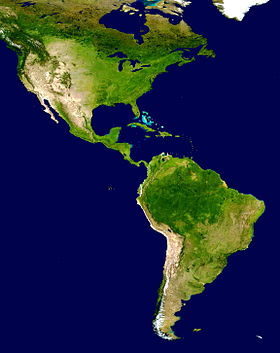
A true-color paradigm of the Americas. Much of the information in the image comes from a single remote-sensing device—NASA'south Moderate Resolution Imaging Spectroradiometer, or MODIS, flying over 700 km above the Earth on lath the Terra satellite in 2001.
The prehistory of the Americas (North, Due south, and Central America, and the Caribbean) begins with people migrating to these areas from Asia during the acme of an Ice Historic period. These groups are generally believed to have been isolated from the people of the "Old World" until the coming of Europeans in the 10th century from Iceland led by Leif Erikson and in 1492 with the voyages of Christopher Columbus.
The ancestors of today's American Ethnic peoples were the Paleo-Indians; they were hunter-gatherers who migrated into North America. The most popular theory asserts that migrants came to the Americas via Beringia, the land mass now covered by the ocean waters of the Bering Strait. Small lithic phase peoples followed megafauna like bison, mammoth (now extinct), and caribou, thus gaining the modernistic nickname "large-game hunters." Groups of people may also have traveled into N America on shelf or sheet ice forth the northern Pacific coast.
Cultures that may be considered advanced or civilized include Norte Chico, Cahokia, Zapotec, Toltec, Olmec, Maya, Aztec, Chimor, Mixtec, Moche, Mississippian, Puebloan, Totonac, Teotihuacan, Huastec people, Purépecha, Izapa, Mazatec, Muisca, and the Inca.[ citation needed ]
Later the voyages of Christopher Columbus in 1492, Spanish and after Portuguese, English language, French and Dutch colonial expeditions arrived in the New World, conquering and settling the discovered lands, which led to a transformation of the cultural and concrete landscape in the Americas. Spain colonized most of the Americas from nowadays-twenty-four hour period Southwestern United states of america, Florida and the Caribbean to the southern tip of South America. Portugal settled in what is mostly nowadays-day Brazil while England established colonies on the Eastern declension of the U.s., besides equally the North Pacific coast and in most of Canada. France settled in Quebec and other parts of Eastern Canada and claimed an area in what is today the cardinal Us. The Netherlands settled New Netherland (authoritative heart New Amsterdam – at present New York), some Caribbean islands and parts of Northern South America.
European colonization of the Americas led to the ascent of new cultures, civilizations and eventually states, which resulted from the fusion of Native American, European, and African traditions, peoples and institutions. The transformation of American cultures through colonization is evident in compages, religion, gastronomy, the arts and particularly languages, the most widespread beingness Spanish (376 1000000 speakers), English (348 million) and Portuguese (201 million). The colonial period lasted approximately three centuries, from the early on 16th to the early on 19th centuries, when Brazil and the larger Hispanic American nations alleged independence. The United States obtained independence from U.k. much earlier, in 1776, while Canada formed a federal dominion in 1867 and received legal independence in 1931. Others remained attached to their European parent land until the end of the 19th century, such equally Cuba and Puerto Rico which were linked to Kingdom of spain until 1898. Smaller territories such as Guyana obtained independence in the mid-20th century, while certain Caribbean area islands and French Guiana remain part of a European power to this day.
Pre-colonization [edit]
Migration into the continents [edit]

The specifics of Paleo-Indian migration to and throughout the Americas, including the exact dates and routes traveled, are subject to ongoing enquiry and discussion.[ane] The traditional theory has been that these early migrants moved into the Beringia state bridge between eastern Siberia and present-day Alaska around 40,000 – 17,000 years ago, when ocean levels were significantly lowered due to the Quaternary glaciation.[1] [2] These people are believed to take followed herds of now-extinct Pleistocene megafauna along ice-free corridors that stretched between the Laurentide and Cordilleran ice sheets.[iii] Another route proposed is that, either on foot or using primitive boats, they migrated down the Pacific Northwest declension to South America.[4] Testify of the latter would since have been covered by a ocean level ascent of a hundred meters following the last ice historic period.[5]
Archaeologists argue that the Paleo-Indian migration out of Beringia (eastern Alaska), ranges from 40,000 to effectually sixteen,500 years agone.[half dozen] [7] [viii] This time range is a hot source of argue. The few agreements achieved to date are the origin from Key Asia, with widespread habitation of the Americas during the end of the last glacial menstruation, or more specifically what is known as the tardily glacial maximum, around 16,000 – xiii,000 years before nowadays.[eight] [9]
The American Periodical of Human Genetics released an article in 2007 stating "Here we bear witness, by using 86 consummate mitochondrial genomes, that all Indigenous American haplogroups, including Haplogroup 10 (mtDNA), were part of a unmarried founding population."[10] Amerindian groups in the Bering Strait region showroom perhaps the strongest Dna or mitochondrial Deoxyribonucleic acid relations to Siberian peoples. The genetic diversity of Amerindian ethnic groups increase with altitude from the assumed entry point into the Americas.[11] [12] Certain genetic diverseness patterns from Westward to E advise, especially in South America, that migration proceeded get-go downwardly the west coast, and so proceeded east.[thirteen] Geneticists have variously estimated that peoples of Asia and the Americas were role of the same population from 42,000 to 21,000 years agone.[14]
New studies shed low-cal on the founding population of indigenous Americans, suggesting that their ancestry traced to both e Asian and western Eurasians who migrated to North America directly from Siberia. A 2013 study in the periodical Nature reported that Dna found in the 24,000-twelvemonth-one-time remains of a immature male child in Mal'ta Siberia suggest that up to one-third of the indigenous Americans may accept ancestry that can be traced dorsum to western Eurasians, who may have "had a more north-easterly distribution 24,000 years ago than commonly thought"[15] Professor Kelly Graf said that "Our findings are significant at two levels. Starting time, information technology shows that Upper Paleolithic Siberians came from a cosmopolitan population of early on modern humans that spread out of Africa to Europe and Central and South Asia. Second, Paleoindian skeletons with phenotypic traits atypical of modern-twenty-four hours Native Americans can be explained as having a direct historical connectedness to Upper Paleolithic Siberia." A route through Beringia is seen as more likely than the Solutrean hypothesis.[sixteen]
On October iii, 2014, the Oregon cave where the oldest DNA evidence of man home in Due north America was found was added to the National Register of Historic Places. The DNA, radiocarbon dated to 14,300 years ago, was found in fossilized human coprolites uncovered in the Paisley Five Mile Signal Caves in s central Oregon.[17]
Lithic stage (before 8000 BCE) [edit]

The Lithic stage or Paleo-Indian period, is the primeval nomenclature term referring to the first stage of homo habitation in the Americas, covering the Late Pleistocene epoch. The time period derives its proper noun from the appearance of "Lithic flaked" rock tools. Rock tools, particularly projectile points and scrapers, are the primary evidence of the earliest well known man action in the Americas. Lithic reduction stone tools are used by archaeologists and anthropologists to classify cultural periods.
Archaic phase (8000 BCE – chiliad BCE) [edit]
Several 1000 years later on the first migrations, the starting time complex civilizations arose as hunter-gatherers settled into semi-agricultural communities. Identifiable sedentary settlements began to emerge in the and then-called Middle Archaic menstruum around 6000 BCE. Particular archaeological cultures can exist identified and easily classified throughout the Archaic period.
In the late Archaic, on the north-central coastal region of Republic of peru, a complex civilization arose which has been termed the Norte Chico culture, also known as Caral-Supe. It is the oldest known civilization in the Americas and one of the half-dozen sites where civilization originated independently and indigenously in the aboriginal world, flourishing between the 30th and 18th centuries BC. It pre-dated the Mesoamerican Olmec civilisation by nearly two millennia. Information technology was contemporaneous with the Egypt post-obit the unification of its kingdom under Narmer and the emergence of the first Egyptian hieroglyphics.
Awe-inspiring architecture, including earthwork platform mounds and sunken plazas have been identified as part of the civilization. Archaeological bear witness points to the use of textile engineering and the worship of common god symbols. Authorities, peradventure in the form of theocracy, is assumed to have been required to manage the region. Nonetheless, numerous questions remain about its organization. In archaeological classification, the culture was pre-ceramic culture of the pre-Columbian Belatedly Archaic flow. It appears to have lacked ceramics and art.
Ongoing scholarly debate persists over the extent to which the flourishing of Norte Chico resulted from its abundant maritime food resources, and the human relationship that these resources would suggest between littoral and inland sites.
The role of seafood in the Norte Chico diet has been a subject of scholarly debate. In 1973, examining the Aspero region of Norte Chico, Michael E. Moseley contended that a maritime subsistence (seafood) economic system had been the basis of society and its early flourishing. This theory, later termed "maritime foundation of Andean Civilisation" was at odds with the general scholarly consensus that civilization arose equally a result of intensive grain-based agriculture, as had been the case in the emergence of civilizations in northeast Africa (Egypt) and southwest Asia (Mesopotamia).
While earlier research pointed to edible domestic plants such as squash, beans, lucuma, guava, pacay, and camote at Caral, publications by Haas and colleagues take added avocado, achira, and maize (Zea Mays) to the list of foods consumed in the region. In 2013, Haas and colleagues reported that maize was a primary component of the diet throughout the period of 3000 to 1800 BC.[18]
Cotton was another widespread ingather in Norte Chico, essential to the production of fishing nets and textiles. Jonathan Haas noted a mutual dependency, whereby "The prehistoric residents of the Norte Chico needed the fish resources for their protein and the fishermen needed the cotton to make the nets to catch the fish."
In the 2005 book 1491: New Revelations of the Americas Before Columbus, journalist Charles C. Mann surveyed the literature at the time, reporting a date "sometime before 3200 BC, and mayhap before 3500 BC" as the beginning date for the formation of Norte Chico. He notes that the primeval date securely associated with a urban center is 3500 BC, at Huaricanga in the (inland) Fortaleza area.
The Norte Chico civilization began to decline around 1800 BC every bit more powerful centers appeared to the south and n forth its declension, and to the e inside the Andes Mountains.
Mesoamerica, the Woodland Menses, and Mississippian culture (2000 BCE – 500 CE) [edit]
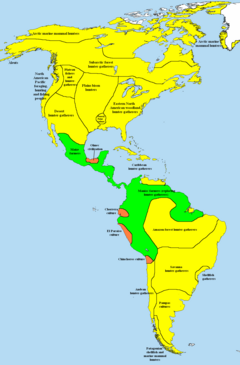
Uncomplicated map of subsistence methods in the Americas at 1000 BCE.
Later on the decline of the Norte Chico civilization, several large, centralized civilizations developed in the Western Hemisphere: Chavin, Nazca, Moche, Huari, Quitus, Cañaris, Chimu, Pachacamac, Tiahuanaco, Aymara and Inca in the Cardinal Andes (Ecuador, Peru and Bolivia); Muisca in Colombia ; Taínos in Dominican Democracy (Hispaniola, Española) and role of Caribbean; and the Olmecs, Maya, Toltecs, Mixtecs, Zapotecs, Aztecs and Purepecha in southern Northward America (United mexican states, Guatemala).
The Olmec civilization was the start Mesoamerican civilization, beginning effectually 1600–1400 BC and ending around 400 BC. Mesoamerica is considered 1 of the six sites around the globe in which civilization adult independently and indigenously. This civilisation is considered the mother culture of the Mesoamerican civilizations. The Mesoamerican agenda, numeral organisation, writing, and much of the Mesoamerican pantheon seem to have begun with the Olmec.
Some elements of agriculture seem to accept been practiced in Mesoamerica quite early. The domestication of maize is thought to have begun effectually 7,500 to 12,000 years agone. The primeval record of lowland maize cultivation dates to around 5100 BC.[19] Agriculture continued to be mixed with a hunting-gathering-angling lifestyle until quite late compared to other regions, but by 2700 BC, Mesoamericans were relying on maize, and living mostly in villages. Temple mounds and classes started to announced. By 1300/ 1200 BC, small centres coalesced into the Olmec civilisation, which seems to have been a set of city-states, united in religious and commercial concerns. The Olmec cities had formalism complexes with globe/clay pyramids, palaces, stone monuments, aqueducts and walled plazas. The kickoff of these centers was at San Lorenzo (until 900 bc). La Venta was the last great Olmec centre. Olmec artisans sculpted jade and clay figurines of Jaguars and humans. Their iconic giant heads – believed to be of Olmec rulers – stood in every major city.
The Olmec civilization concluded in 400 BC, with the defacing and destruction of San Lorenzo and La Venta, two of the major cities. It nevertheless spawned many other states, well-nigh notably the Mayan civilization, whose first cities began appearing effectually 700–600 BC. Olmec influences continued to announced in many after Mesoamerican civilizations.
Cities of the Aztecs, Mayas, and Incas were every bit big and organized every bit the largest in the Old World, with an estimated population of 200,000 to 350,000 in Tenochtitlan, the capital of the Aztec Empire. The market established in the urban center was said to take been the largest ever seen past the conquistadors when they arrived. The capital of the Cahokians, Cahokia, located most mod Due east St. Louis, Illinois, may have reached a population of over xx,000. At its top, between the twelfth and 13th centuries, Cahokia may have been the most populous urban center in North America. Monk'south Mound, the major ceremonial centre of Cahokia, remains the largest earthen construction of the prehistoric New Globe.
These civilizations developed agriculture as well, breeding maize (corn) from having ears 2–5 cm in length to peradventure x–xv cm in length. Potatoes, tomatoes, beans (greens), pumpkins, avocados, and chocolate are now the most pop of the pre-Columbian agricultural products. The civilizations did not develop extensive livestock as there were few suitable species, although alpacas and llamas were domesticated for use as beasts of burden and sources of wool and meat in the Andes. By the 15th century, maize was being farmed in the Mississippi River Valley subsequently introduction from Mexico. The course of further agricultural development was profoundly altered by the inflow of Europeans.
Classic phase (800 BCE – 1533 CE) [edit]

Pre-contact: distribution of North American language families, including northern Mexico
- Cahokia
Cahokia was a major regional chiefdom, with trade and tributary chiefdoms located in a range of areas from bordering the Great Lakes to the Gulf of Mexico.
- Haudenosaune
The Iroquois League of Nations or "People of the Long House", based in present-day upstate and western New York, had a confederacy model from the mid-15th century. It has been suggested that their culture contributed to political thinking during the evolution of the afterward United States government. Their system of amalgamation was a kind of federation, different from the strong, centralized European monarchies.[twenty] [21] [22]
Leadership was restricted to a group of fifty sachem chiefs, each representing one clan inside a tribe; the Oneida and Mohawk people had 9 seats each; the Onondagas held 14; the Cayuga had ten seats; and the Seneca had eight. Representation was not based on population numbers, as the Seneca tribe greatly outnumbered the others. When a sachem main died, his successor was chosen by the senior woman of his tribe in consultation with other female members of the association; property and hereditary leadership were passed matrilineally. Decisions were not fabricated through voting only through consensus conclusion making, with each sachem chief holding theoretical veto power. The Onondaga were the "firekeepers", responsible for raising topics to exist discussed. They occupied one side of a three-sided fire (the Mohawk and Seneca sat on one side of the fire, the Oneida and Cayuga sat on the tertiary side.)[22]
Long-altitude trading did not prevent warfare and displacement among the ethnic peoples, and their oral histories tell of numerous migrations to the historic territories where Europeans encountered them. The Iroquois invaded and attacked tribes in the Ohio River area of present-day Kentucky and claimed the hunting grounds. Historians have placed these events as occurring as early on every bit the 13th century, or in the 17th century Beaver Wars.[23]
Through warfare, the Iroquois drove several tribes to migrate west to what became known equally their historically traditional lands west of the Mississippi River. Tribes originating in the Ohio Valley who moved west included the Osage, Kaw, Ponca and Omaha people. By the mid-17th century, they had resettled in their historical lands in nowadays-24-hour interval Kansas, Nebraska, Arkansas and Oklahoma. The Osage warred with Caddo-speaking Native Americans, displacing them in plough by the mid-18th century and dominating their new historical territories.[23]
Oasisamerica [edit]
- Pueblo people
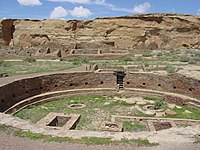


The Pueblo people of what is now occupied by the Southwestern United States and northern Mexico, living weather condition were that of large stone apartment like adobe structures. They alive in Arizona, New Mexico, Utah, Colorado, and possibly surrounding areas.
Aridoamerica [edit]
- Chichimeca
Chichimeca was the name that the Mexica (Aztecs) generically applied to a wide range of semi-nomadic peoples who inhabited the north of modernistic-solar day United mexican states, and carried the same sense every bit the European term "barbarian". The name was adopted with a pejorative tone by the Spaniards when referring peculiarly to the semi-nomadic hunter-gatherer peoples of northern Mexico.
Mesoamerica [edit]
- Olmec
The Olmec civilization emerged around 1200 BCE in Mesoamerica and concluded around 400 BCE. Olmec art and concepts influenced surrounding cultures afterwards their downfall. This culture was thought to be the commencement in America to develop a writing system. After the Olmecs abandoned their cities for unknown reasons, the Maya, Zapotec and Teotihuacan arose.
- Purepecha
The Purepecha civilization emerged effectually 1000 CE in Mesoamerica . They flourished from 1100 CE to 1530 CE. They continue to live on in the state of Michoacán. Fierce warriors, they were never conquered and in their celebrity years, successfully sealed off huge areas from Aztec domination.
- Maya
Maya history spans 3,000 years. The Classic Maya may have collapsed due to changing climate in the finish of the 10th century.
- Toltec
The Toltec were a nomadic people, dating from the 10th–12th century, whose language was also spoken past the Aztecs.
- Teotihuacan
Teotihuacan (fourth century BCE – vii/eighth century CE) was both a urban center, and an empire of the same name, which, at its zenith between 150 and the 5th century, covered most of Mesoamerica.
- Aztec
The Aztec having started to build their empire around 14th century establish their civilisation abruptly ended by the Spanish conquistadors. They lived in Mesoamerica, and surrounding lands. Their upper-case letter city Tenochtitlan was one of the largest cities of all time.
Southward America [edit]

- Norte Chico
The oldest known civilization of the Americas was established in the Norte Chico region of modern Peru. Complex society emerged in the group of coastal valleys, between 3000 and 1800 BCE. The Quipu, a distinctive recording device among Andean civilizations, evidently dates from the era of Norte Chico's prominence.
- Chavín
The Chavín established a merchandise network and developed agriculture by as early as (or late compared to the One-time World) 900 BCE co-ordinate to some estimates and archaeological finds. Artifacts were found at a site chosen Chavín in modern Peru at an elevation of three,177 meters. Chavín civilization spanned from 900 BCE to 300 BCE.
- Inca
Belongings their capital at the great city of Cusco, the Inca civilization dominated the Andes region from 1438 to 1533. Known as Tahuantinsuyu, or "the state of the four regions", in Quechua, the Inca civilization was highly singled-out and developed. Cities were built with precise, unmatched stonework, constructed over many levels of mountain terrain. Terrace farming was a useful form of agriculture. There is evidence of first-class metalwork and even successful trepanation of the skull in Inca civilization.
European colonization [edit]

Non-Native American nations' claims over Northward America, 1750–1999.

Political development of Central America and the Caribbean area since 1700.

European nations' control over South America, 1700 to nowadays
Around m, the Vikings established a short-lived settlement in Newfoundland, now known every bit Fifty'Anse aux Meadows. Speculations exist about other One-time World discoveries of the New World, but none of these are by and large or completely accepted past about scholars.
Spain sponsored a major exploration led by Italian explorer Christopher Columbus in 1492; it quickly led to extensive European colonization of the Americas. The Europeans brought Onetime World diseases which are thought to have acquired catastrophic epidemics and a huge decrease of the native population. Columbus came at a time in which many technical developments in sailing techniques and advice made it possible to report his voyages hands and to spread give-and-take of them throughout Europe. Information technology was also a time of growing religious, majestic and economic rivalries that led to a contest for the establishment of colonies.
Colonial menstruum [edit]
15th to 19th century colonies in the New World:
- Spanish colonization of the Americas (1492)
- Viceroyalty of New Spain (1535 to 1821)
- Viceroyalty of Peru (1542–1824)
- Spanish Master
- Spanish West Indies
- Captaincy Full general of Guatemala
- British America / Xiii Colonies (1584/1607 to 1776/20th century)
- Danish West Indies
- New Netherland
- New France
- Captaincy General of Venezuela
- Portuguese colonization of the Americas (1499 to 1822)
- Colonial Brazil (1500 to 1815)
Decolonization [edit]
The formation of sovereign states in the New World began with the U.s.a. Annunciation of Independence of 1776. The American Revolutionary State of war lasted through the menses of the Siege of Yorktown — its final major campaign — in the early autumn of 1781, with peace being achieved in 1783.
The Spanish colonies won their independence in the outset quarter of the 19th century, in the Spanish American wars of independence. Simón Bolívar and José de San Martín, among others, led their independence struggle. Although Bolivar attempted to keep the Spanish-speaking parts of Latin America politically allied, they apace became independent of one another as well, and several further wars were fought, such as the Paraguayan War and the War of the Pacific. (See Latin American integration.) In the Portuguese colony Dom Pedro I (also Pedro IV of Portugal), son of the Portuguese male monarch Dom João VI, proclaimed the country's independence in 1822 and became Brazil's showtime Emperor. This was peacefully accustomed by the crown in Portugal, upon bounty.
Effects of slavery [edit]
Slavery has had a significant role in the economic development of the New World after the colonization of the Americas past the Europeans. The cotton, tobacco, and sugar cane harvested by slaves became important exports for the United States and the Caribbean area countries.
20th century [edit]
North America [edit]

A Canadian World War I recruiting poster (1914–1918)
As a part of the British Empire, Canada immediately entered World War I when it broke out in 1914. Canada diameter the brunt of several major battles during the early stages of the war, including the use of poison gas attacks at Ypres. Losses became grave, and the government eventually brought in conscription, despite the fact this was confronting the wishes of the bulk of French Canadians. In the ensuing Conscription Crisis of 1917, riots broke out on the streets of Montreal. In neighboring Newfoundland, the new dominion suffered a devastating loss on July 1, 1916, the First day on the Somme.
The United States stayed out of the disharmonize until 1917, when it joined the Entente powers. The United States was then able to play a crucial role at the Paris Peace Briefing of 1919 that shaped interwar Europe. United mexican states was not part of the war, equally the land was embroiled in the Mexican Revolution at the fourth dimension.
The 1920s brought an age of great prosperity in the United States, and to a bottom degree Canada. But the Wall Street Crash of 1929 combined with drought ushered in a menstruation of economic hardship in the United States and Canada. From 1936 to 1949, at that place was a pop uprising confronting the anti-Cosmic Mexican government of the fourth dimension, set off specifically past the anti-clerical provisions of the Mexican Constitution of 1917.
Again, Canada plant itself at war before its neighbors, with numerically modest but significant contributions overseas such as the Battle of Hong Kong and the Battle of Britain. The entry of the United States into the war helped to tip the residuum in favour of the allies. Two Mexican tankers, transporting oil to the United States, were attacked and sunk past the Germans in the Gulf of Mexico waters, in 1942. The incident happened in spite of United mexican states's neutrality at that time. This led United mexican states to enter the conflict with a declaration of war on the Axis nations. The destruction of Europe wrought by the war vaulted all North American countries to more important roles in world diplomacy, especially the U.s., which emerged every bit a "superpower".
The early Common cold War era saw the The states equally the most powerful nation in a Western coalition of which Mexico and Canada were also a role. In Canada, Quebec was transformed by the Quiet Revolution and the emergence of Quebec nationalism. Mexico experienced an era of huge economic growth afterward World War II, a heavy industrialization procedure and a growth of its centre class, a menstruum known in Mexican history as "El Milagro Mexicano" (the Mexican miracle). The Caribbean saw the beginnings of decolonization, while on the largest island the Cuban Revolution introduced Common cold State of war rivalries into Latin America.
The civil rights movement in the U.S. ended Jim Crow and empowered black voters in the 1960s, which immune black citizens to move into loftier government offices for the commencement time since Reconstruction. Nevertheless, the ascendant New Bargain coalition collapsed in the mid 1960s in disputes over race and the Vietnam War, and the conservative motility began its rise to power, as the one time dominant liberalism weakened and collapsed. Canada during this era was dominated by the leadership of Pierre Elliot Trudeau. In 1982, at the terminate of his tenure, Canada enshrined a new constitution.
Canada's Brian Mulroney not only ran on a similar platform but also favored closer trade ties with the United States. This led to the Canada-U.s.a. Free Trade Understanding in January 1989. Mexican presidents Miguel de la Madrid, in the early 1980s and Carlos Salinas de Gortari in the tardily 1980s, started implementing liberal economic strategies that were seen as a expert move. However, United mexican states experienced a strong economic recession in 1982 and the Mexican peso suffered a devaluation. In the The states president Ronald Reagan attempted to move the United states of america dorsum towards a difficult anti-communist line in foreign diplomacy, in what his supporters saw every bit an attempt to assert moral leadership (compared to the Soviet Wedlock) in the world community. Domestically, Reagan attempted to bring in a package of privatization and regulation to stimulate the economy.
The cease of the Cold State of war and the offset of the era of sustained economical expansion coincided during the 1990s. On January 1, 1994, Canada, United mexican states and the U.s.a. signed the North American Gratis Trade Agreement, creating the world'due south largest free trade area. In 2000, Vicente Fox became the kickoff non-PRI candidate to win the Mexican presidency in over seventy years. The optimism of the 1990s was shattered by the 9/xi attacks of 2001 on the U.s., which prompted military intervention in Afghanistan, which too involved Canada. Canada did not support the United States' later on move to invade Republic of iraq, withal.
In the U.S. the Reagan Era of bourgeois national policies, deregulation and tax cuts took control with the election of Ronald Reagan in 1980. By 2010, political scientists were debating whether the election of Barack Obama in 2008 represented an end of the Reagan Era, or was only a reaction against the bubble economy of the 2000s (decade), which outburst in 2008 and became the Tardily-2000s recession with prolonged unemployment.
Cardinal America [edit]
Despite the failure of a lasting political union, the concept of Central American reunification, though lacking enthusiasm from the leaders of the individual countries, rises from time to fourth dimension. In 1856–1857 the region successfully established a military coalition to repel an invasion by The states adventurer William Walker. Today, all 5 nations fly flags that retain the sometime federal motif of ii outer bluish bands bounding an inner white stripe. (Republic of costa rica, traditionally the least committed of the 5 to regional integration, modified its flag significantly in 1848 by concealment the blue and adding a double-wide inner crimson band, in honor of the French tricolor).
In 1907, a Fundamental American Courtroom of Justice was created. On Dec xiii, 1960, Republic of guatemala, El Salvador, Honduras, and Nicaragua established the Primal American Common Marketplace ("CACM"). Republic of costa rica, considering of its relative economical prosperity and political stability, chose not to participate in the CACM. The goals for the CACM were to create greater political unification and success of import substitution industrialization policies. The projection was an immediate economic success, but was abased later on the 1969 "Football War" betwixt El Salvador and Honduras. A Central American Parliament has operated, as a purely advisory body, since 1991. Costa Rica has repeatedly declined invitations to join the regional parliament, which seats deputies from the four other onetime members of the Union, likewise every bit from Panama and the Dominican Republic.
South America [edit]
In the 1960s and 1970s, the governments of Argentina, Brazil, Chile, and Uruguay were overthrown or displaced by U.S.-aligned military dictatorships. These dictatorships detained tens of thousands of political prisoners, many of whom were tortured and/or killed (on inter-state collaboration, come across Operation Condor). Economically, they began a transition to neoliberal economic policies. They placed their own actions within the United States Common cold War doctrine of "National Security" confronting internal subversion. Throughout the 1980s and 1990s, Republic of peru suffered from an internal disharmonize (encounter Túpac Amaru Revolutionary Movement and Shining Path). Revolutionary movements and right-wing military dictatorships have been common, but starting in the 1980s a moving ridge of democratization came through the continent, and democratic rule is widespread now. Allegations of corruption remain common, and several nations have seen crises which have forced the resignation of their presidents, although normal civilian succession has continued.
International indebtedness became a notable problem, every bit most recently illustrated by Argentina's default in the early 21st century. In recent years, Southward American governments have drifted to the left, with socialist leaders existence elected in Chile, Republic of bolivia, Brazil, Venezuela, and a leftist president in Argentina and Uruguay. Despite the move to the left, South America is still largely capitalist. With the founding of the Union of Southward American Nations, Due south America has started downwards the road of economic integration, with plans for political integration in the European union fashion.
| Country or Territory with flag | Area (km²)[24] (per sq mi) | Population (July 2009 est.)[24] | Population density per km² | Capital |
|---|---|---|---|---|
 Argentina Argentina | 2,766,890 kmii (1,068,300 sq mi) | 40,482,000 | 14.3/km² (37/sq mi) | Buenos Aires |
 Republic of bolivia Republic of bolivia | 1,098,580 km2 (424,160 sq mi) | ix,863,000 | 8.4/km² (21.viii/sq mi) | La Paz[25] |
 Brazil Brazil | 8,514,877 km2 (3,287,612 sq mi) | 191,241,714 | 22.0/km² (57/sq mi) | Brasília |
 Chile [26] Chile [26] | 756,950 km2 (292,260 sq mi) | 16,928,873 | 22/km² (57/sq mi) | Santiago |
 Republic of colombia Republic of colombia | 1,138,910 km2 (439,740 sq mi) | 45,928,970 | 40/km² (103.half dozen/sq mi) | Bogotá |
 Ecuador Ecuador | 283,560 km2 (109,480 sq mi) | xiv,573,101 | 53.8/km² (139.three/sq mi) | Quito |
 Falkland Islands (United Kingdom)[27] Falkland Islands (United Kingdom)[27] | 12,173 km2 (4,700 sq mi) | iii,140[28] | 0.26/km² (0.7/sq mi) | Stanley |
 French Guiana (French republic) French Guiana (French republic) | 91,000 kmii (35,000 sq mi) | 221,500[29] | ii.7/km² (v.4/sq mi) | Cayenne |
 Guyana Guyana | 214,999 km2 (83,012 sq mi) | 772,298 | iii.five/km² (ix.1/sq mi) | Georgetown |
 Paraguay Paraguay | 406,750 km2 (157,050 sq mi) | 6,831,306 | 15.half-dozen/km² (40.4/sq mi) | Asunción |
 Peru Peru | one,285,220 km2 (496,230 sq mi) | 29,132,013 | 22/km² (57/sq mi) | Lima |
 Southward Georgia and Southward Georgia andSouth Sandwich Islands (United Kingdom) [xxx] | 3,093 kmtwo (1,194 sq mi) | twenty | 0/km² (0/sq mi) | Grytviken |
 Suriname Suriname | 163,270 km2 (63,040 sq mi) | 472,000 | 3/km² (seven.8/sq mi) | Paramaribo |
 Uruguay Uruguay | 176,220 kmtwo (68,040 sq mi) | 3,477,780 | 19.4/km² (fifty.2/sq mi) | Montevideo |
 Venezuela Venezuela | 916,445 km2 (353,841 sq mi) | 26,814,843 | 30.2/km² (72/sq mi) | Caracas |
| Full | 17,824,513 | 385,742,554 | 21.five/km² |
See also [edit]
- History of the west declension of North America
- History of the Caribbean
- History of Latin America
- History of the Southern United States
- American Quondam Due west
- History of New England
- Spanish Empire
- Portuguese Empire
- List of oldest buildings in the Americas
Notes [edit]
- ^ a b "Atlas of the Man Journey-The Genographic Project". National Geographic Guild. 1996–2008. Archived from the original on 2011-05-01. Retrieved 2009-10-06 .
- ^ Fitzhugh, Drs. William; Goddard, Ives; Ousley, Steve; Owsley, Doug; Stanford., Dennis. "Paleoamerican". Smithsonian Institution Anthropology Outreach Office. Archived from the original on 2009-01-05. Retrieved 2009-01-15 .
- ^ "The peopling of the Americas: Genetic ancestry influences health". Scientific American . Retrieved 2009-11-17 .
- ^ Fladmark, M. R. (1979). "Alternate Migration Corridors for Early Man in North America". American Antiquity. 44 (1): 55–69. doi:10.2307/279189. JSTOR 279189.
- ^ "68 Responses to "Sea will rise 'to levels of concluding Ice Historic period'"". Center for Climate Systems Research, Columbia University . Retrieved 2009-11-17 .
- ^ "Introduction". Government of Canada. Parks Canada. 2009. Archived from the original on 2011-04-24. Retrieved 2010-01-09 .
Canada's oldest known home is a cave in Yukon occupied not 12,000 years agone like the U.S. sites, just at to the lowest degree xx,000 years ago
- ^ "Pleistocene Archeology of the Old Crow Flats". Vuntut National Park of Canada. 2008. Archived from the original on 2008-10-22. Retrieved 2010-01-10 .
However, despite the lack of this conclusive and widespread evidence, there are suggestions of homo occupation in the northern Yukon nigh 24,000 years ago, and hints of the presence of humans in the Old Crow Basin as far back every bit most 40,000 years ago.
- ^ a b "Journeying of mankind". Brad Shaw Foundation . Retrieved 2009-11-17 .
- ^ Bonatto, SL; Salzano, FM (1997). "A single and early migration for the peopling of the Americas supported by mitochondrial DNA sequence information". Proceedings of the National Academy of Sciences of the U.s.a. of America. 94 (v): 1866–71. Bibcode:1997PNAS...94.1866B. doi:10.1073/pnas.94.v.1866. PMC20009. PMID 9050871.
- ^ "First Americans". Southern Methodist University-David J. Meltzer, B.A., 1000.A., Ph. D . Retrieved 2009-11-17 .
- ^ "The peopling of the Americas: Genetic beginnings influences wellness". Scientific American . Retrieved 2009-11-22 .
- ^ "Get-go Americans Endured twenty,000-Year Layover - Jennifer Viegas, Discovery News". Archived from the original on 2012-03-thirteen. Retrieved 2009-eleven-18 .
- ^ Wang, Sijia; Lewis, Cecil M.; Jakobsson, Mattias; Ramachandran, Sohini; Ray, Nicolas; Bedoya, Gabriel; Rojas, Winston; Parra, Maria V.; Molina, Julio A.; Gallo, Carla; Mazzotti, Guido; Poletti, Giovanni; Hill, Kim; Hurtado, Ana M.; Labuda, Damian; Klitz, William; Barrantes, Ramiro; Bortolini, Maria Cátira; Salzano, Francisco M.; Petzl-Erler, Maria Luiza; Tsuneto, Luiza T.; Llop, Elena; Rothhammer, Francisco; Excoffier, Laurent; Feldman, Marcus Due west.; Rosenberg, Noah A.; Ruiz-Linares, Andrés (2007). "Genetic Variation and Population Structure in Native Americans". PLOS Genetics. 3 (11): 3(11). doi:10.1371/journal.pgen.0030185. PMC2082466. PMID 18039031.
- ^ Fagundes, Nelson J.R.; Ricardo Kanitz; Roberta Eckert; Ana C.S. Valls; Mauricio R. Bogo; Francisco M. Salzano; David Glenn Smith; Wilson A. Silva; Marco A. Zago; Andrea Thou. Ribeiro-dos-Santos; Sidney East.B. Santos; Maria Luiza Petzl-Erler; Sandro Fifty. Bonatto (2008). "Mitochondrial Population Genomics Supports a Single Pre-Clovis Origin with a Coastal Route for the Peopling of the Americas" (PDF). American Journal of Homo Genetics. 82 (3): 583–592. doi:10.1016/j.ajhg.2007.xi.013. PMC2427228. PMID 18313026. Archived from the original (PDF) on 2009-03-25. Retrieved 2009-xi-xix .
- ^ Maanasa Raghavan; Pontus Skoglund; Kelly E. Graf; Mait Metspalu; Anders Albrechtsen; Ida Moltke; Simon Rasmussen; Thomas W. Stafford Jr; Ludovic Orlando; Ene Metspalu; Monika Karmin; Kristiina Tambets; Siiri Rootsi; Reedik Mägi; Paula F. Campos; Elena Balanovska; Oleg Balanovsky; Elza Khusnutdinova; Sergey Litvinov; Ludmila P. Osipova; Sardana A. Fedorova; Mikhail I. Voevoda; Michael DeGiorgio; Thomas Sicheritz-Ponten; Søren Brunak; Svetlana Demeshchenko; Toomas Kivisild; Richard Villems; Rasmus Nielsen; Mattias Jakobsson; Eske Willerslev (2013). "Upper Palaeolithic Siberian genome reveals dual ancestry of Native Americans". Nature. 505 (7481): 87–91. Bibcode:2014Natur.505...87R. doi:x.1038/nature12736. PMC4105016. PMID 24256729.
- ^ "Ancient Siberian genome reveals genetic origins of Native Americans". PHYSORG. Nov 20, 2013. Retrieved 23 Nov 2013.
- ^ Staff (iii October 2014). "Cave containing primeval human Dna dubbed historic". Phys.org . Retrieved 5 Oct 2014.
- ^ Haas, Jonathan; Winifred Creamer; Luis Huamán Mesía; David Goldstein; Karl Reinhard; Cindy Vergel Rodríguez (2013). "Show for maize (Zea mays) in the Belatedly Archaic (3000–1800 B.C.) in the Norte Chico region of Peru". Proceedings of the National Academy of Sciences of the Us. 110 (xiii): 4945–4949. Bibcode:2013PNAS..110.4945H. doi:ten.1073/pnas.1219425110. PMC3612639. PMID 23440194.
New data drawn from coprolites, pollen records, and stone tool residues, combined with 126 radiocarbon dates, demonstrate that maize was widely grown, intensively processed, and constituted a primary component of the diet throughout the catamenia from 3000 to 1800 B.C.
- ^ "Agriculture's origin may be hidden in 'invisible' clues". Scienceblog.com. 2003-02-14. Retrieved 2009-04-eighteen .
- ^ Woods, Thomas Eastward (2007). 33 questions nigh American history y'all're non supposed to ask. Crown Forum. p. 62. ISBN978-0-307-34668-i.
- ^ Wright, R (2005). Stolen Continents: 500 Years of Conquest and Resistance in the Americas. Mariner Books. ISBN978-0-618-49240-4.
- ^ a b Tooker Due east (1990). "The United states of america Constitution and the Iroquois League". In Clifton JA (ed.). The Invented Indian: Cultural Fictions and Government Policies. New Brunswick, N.J.: Transaction Publishers. pp. 107–128. ISBN978-i-56000-745-6.
- ^ a b Burns, LF. "Osage". Oklahoma Encyclopedia of History and Culture. Archived from the original on 2011-01-02. Retrieved 2010-eleven-29 .
- ^ a b State areas and population estimates are taken from The 2008 Globe Factbook which currently uses July 2007 data, unless otherwise noted.
- ^ La Paz is the administrative capital of Republic of bolivia;
- ^ Includes Easter Island in the Pacific Ocean, a Chilean territory ofttimes reckoned in Oceania. Santiago is the administrative uppercase of Chile; Valparaíso is the site of legislative meetings.
- ^ Claimed by Argentina.
- ^ Falkland Islands: July 2008 population estimate. CIA World Factbook.
- ^ (January 2009) INSEE, Regime of France. "Population des régions au 1er janvier" (in French). Retrieved 2009-01-20 .
- ^ Claimed past Argentina; the South Georgia and the South Sandwich Islands in the South Atlantic Ocean are unremarkably associated with Antarctica (due to proximity) and accept no permanent population, merely hosting a periodic contingent of about 100 researchers and visitors.
Further reading [edit]
- Boyer, Paul Southward. The Oxford Companion to United States History (2001) excerpt and text search; online at many libraries
- Carnes, Mark C., and John A. Garraty. The American Nation: A History of the United states: AP Edition (2008)
- Egerton, Douglas R. et al. The Atlantic World: A History, 1400–1888 (2007), higher textbook; 530pp
- Elliott, John H. Empires of the Atlantic Earth: Britain and Spain in America 1492–1830 (2007), 608pp excerpt and text search, advanced synthesis
- Hardwick, Susan W., Fred M. Shelley, and Donald Thou. Holtgrieve. The Geography of North America: Environment, Political Economy, and Civilization (2007)
- Jacobs, Heidi Hayes, and Michal L. LeVasseur. World Studies: Latin America: Geography – History – Culture (2007)
- Bruce Eastward. Johansen, The Native Peoples of North America: A History (2006)
- Kaltmeier, Olaf, Josef Raab, Michael Stewart Foley, Alice Nash, Stefan Rinke, and Mario Rufer. The Routledge Handbook to the History and Society of the Americas. New York: Routledge (2019)
- Keen, Benjamin, and Keith Haynes. A History of Latin America (2008)
- Kennedy, David M., Lizabeth Cohen, and Thomas Bailey. The American Pageant (2 vol 2008), U.S. history
- The Canadian Encyclopedia
- Morton, Desmond. A Curt History of Canada 5th ed (2001)
- Veblen, Thomas T. Kenneth R. Young, and Antony R. Orme. The Physical Geography of Due south America (2007)

Source: https://en.wikipedia.org/wiki/History_of_the_Americas
Posted by: jacobsimption.blogspot.com
0 Response to "Who Was The Reporter Who Was Dragged From His Van And Shot On Camera In South America"
Post a Comment